













 Algeria
  Bahrain
  Egypt
Egypt  Iran
Iran  Iraq
Iraq  Israel
  Jordan
  Kuwait
  Lebanon
  Libya
Libya  Morocco
  Oman
Oman  Palestine *
  Qatar
Qatar  Saudi Arabia
  Syria
Syria  Tunisia
  United Arab Emirates
 Decarbonising aviation: a strategic pathway through eSAF and regional cooperation


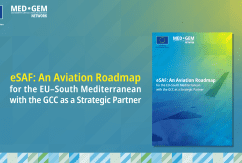
A new MED-GEM Network report focuses on electro-SAF (eSAF), a next-generation fuel produced from renewable electricity, green hydrogen and captured CO₂. Unlike alternative propulsion technologies, eSAF can be deployed within existing aircraft and fuel infrastructure, offering a practical and scalable pathway to reduce lifecycle emissions in the aviation sector.
The European Union has established a strong policy framework to accelerate the uptake of SAF, notably through the ReFuelEU Aviation regulation, which sets binding targets for sustainable fuel blending. However, current supply remains limited. SAF production today represents only a marginal share of global jet fuel demand, highlighting the need to scale up production pathways beyond existing bio-based routes, which are constrained by feedstock availability. In this context, eSAF is expected to play a critical role in the long term, enabling large-scale production independent of biomass constraints.
The report identifies a clear opportunity to position the EU–South Mediterranean–GCC region as a strategic corridor for eSAF development. This approach builds on complementary strengths:
- European Union: regulatory leadership and demand creation
- Southern Mediterranean partner countries: high renewable energy potential and proximity to EU markets
- Gulf countries (GCC): access to capital, infrastructure and industrial scale
By aligning these assets, the region can support the development of integrated value chains for eSAF production, transport and export. This vision is fully consistent with the objectives of the New Pact for the Mediterranean and contributes to the operationalisation of the Trans-Mediterranean Renewable Energy and Clean-Tech Cooperation (T-MED) initiative.