





























 Algeria
  Bahrain
  Egypt
Egypt  Iran
Iran  Iraq
Iraq  Israel
  Jordan
  Kuwait
  Lebanon
  Libya
Libya  Morocco
  Oman
Oman  Palestine *
  Qatar
Qatar  Saudi Arabia
  Syria
Syria  Tunisia
  United Arab Emirates
  Yemen
Yemen Effective Migration Governance: Policy Impacts and Trade-Offs
 05 Oct
to 07 Oct
05 Oct
to 07 Oct
 Florence, Italy
 Florence School of Transnational Governance, Migration Policy Centre


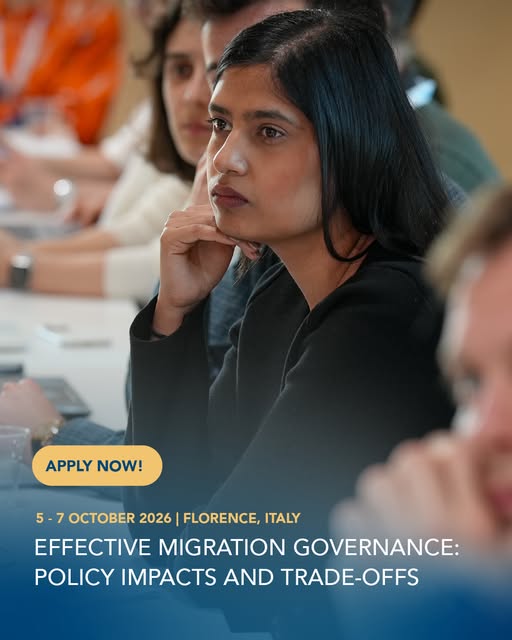
In its 6th edition, taking place in Florence from 5 to 7 October, this executive training course provides original strategies to navigate dilemmas and trade-offs in migration governance. The programme is based on cross-cutting research and provides instruments to manage conflicts, apply critical thinking, and take advantage of exceptional networking opportunities with academics, civil society experts, journalists, practitioners, and policymakers in the field of migration governance.
A key strength of this course is the combination of theoretical principles, practical tools, and case studies. Knowledge from migration theory and empirical research will be combined with professional insights about tensions and trade-offs arising from political processes and practical perspectives that occur at the operational level. Through peer-learning activities, case study work, dedicated mentoring sessions, and interactive exchanges, the training provides a unique learning experience.
The trade-offs and policy dilemmas that will be studied in the course concern:
- External action and migration partnerships
- Integration policy
- Labour migration
- Policies to address irregular migration
- Reception of asylum seekers
- Refugee pathways
- Service provision of civil society organisations to migrant populations
- Transnational migration governance
This training course is designed for early to mid-career professionals working on asylum and refugee protection, labour migration, migration management, border management, discrimination, displacement, emigration, human trafficking, immigration, integration, social cohesion, and statelessness. The programme content is primarily based on research in Europe, but examples from other regions will be provided and discussed.
Learning methods
- Knowledge transfer sessions led by experienced policy-practitioners and academics;
- Combination of theoretical approaches, case studies, and simulation activities;
- Peer-learning setting with professionals with different backgrounds and roles in migration
Learning outcomes
By the end of this programme, the participants will be able to:
- Incorporate research findings about dynamics of migration and migration governance into policy design and practice;
- Learn about migration policy implementation;
- Understand how public institutions can identify and address public concerns around migration;
- Connect with a range of important stakeholders in the field of migration management
Who should attend
- Consultants and private experts
- International organisations’ staff
- Members of think tanks or civil society organisations
- Professionals working in NGOs or government agencies
- Journalists and communication professionals
- Researchers at an advanced stage of their PhD or postdoctoral level
Information for applicants
- The training course will take place in a fully residential mode on 5-6-7 October 2026. Registrants who are selected will be expected to be present on the EUI campus in Florence, Italy, on the days of the course.
- The programme will include approximately 20 teaching hours.
- Participants will have access to an exclusive Virtual Learning Environment (Brightspace) through which they will have access to extensive course materials, including academic articles, policy reports, and research data.
- As instructors will guide you through the course content, participants will not be required to do readings or preparation before the start of the training, but instead can rely on the materials as a useful resource to go back to key arguments after the training.
Countries covered:
-
 Algeria
-
Bahrain
-
Egypt
-
Iran
-
Iraq
-
Israel
-
Jordan
-
Kuwait
-
Lebanon
-
Libya
-
Morocco
-
Oman
-
Palestine *
-
Qatar
-
Saudi Arabia
-
Syria
-
Tunisia
-
United Arab Emirates
-
Yemen