






 Algeria
  Bahrain
  Egypt
Egypt  Iran
Iran  Iraq
Iraq  Israel
  Jordan
  Kuwait
  Lebanon
  Libya
Libya  Morocco
  Oman
Oman  Palestine *
  Qatar
Qatar  Saudi Arabia
  Syria
Syria  Tunisia
  United Arab Emirates
  Yemen
Yemen At the UfM Energy Platform, Mediterranean Energy Platforms Speak with One Voice on T-MED


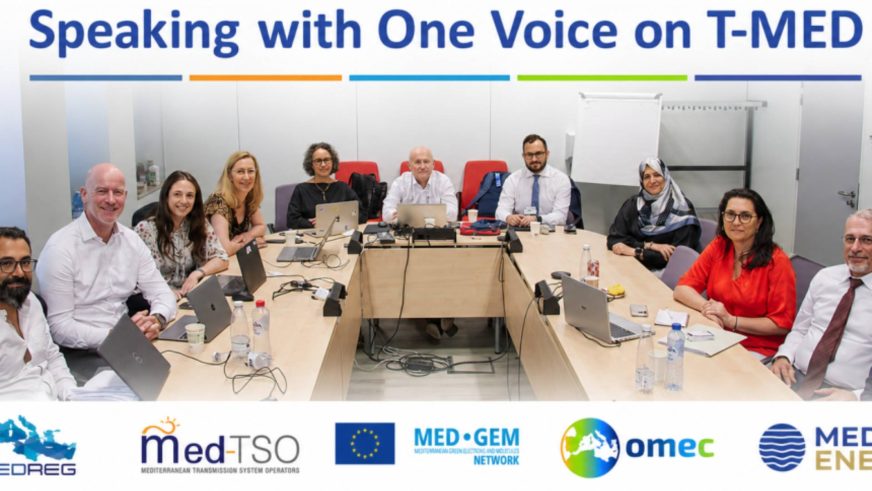
At the Union for the Mediterranean Energy Platform, regional energy stakeholders took a concrete step toward turning the Trans-Mediterranean Renewable Energy and Clean-Tech Cooperation Initiative, T-MED, into a shared Mediterranean delivery agenda. The presentation, delivered by Frank Wouters, Director of the MED-GEM Network, carried the title “Speaking with One Voice on T-MED” and brought together the contributions of five regional energy platforms: MEDREG, Med-TSO, MED-GEM, OMEC and MedENER. The message was clear: T-MED will not succeed by creating parallel structures. It will succeed by connecting what already exists: regulation, grids, data, industry, skills and investment — into one coherent implementation framework.
The 1 July presentation built directly on the outcomes of the T-MED Technical Coordination Workshop, organised the previous day in Brussels with the participation of MEDREG, Med-TSO, MED-GEM, OMEC, MedENER, RCREEE, the European Commission’s DG MENA and DG ENER, and regional energy stakeholders. The workshop aimed to move T-MED from strategic framework to operational delivery. Discussions focused on what the initiative now needs from regional platforms: regulatory intelligence that makes projects bankable, infrastructure planning aligned with industrial development, green hydrogen readiness, skills, finance, manufacturing, energy efficiency and credible data for investment decisions. During the workshop, T-MED was framed not as an export-only agenda, but as a win-win partnership under the Pact for the Mediterranean. Its purpose is to unlock the Southern Mediterranean’s renewable energy and clean-technology potential while supporting domestic decarbonisation, affordable energy, industrial development, job creation and energy security on both shores.
At the UfM Energy Platform, each organisation presented its comparative advantage and its potential contribution to T-MED implementation. MEDREG brings regulatory convergence and investor confidence, including country reviews, regulatory profiles, investment dialogue and capacity building. Med-TSO contributes expertise on grids, interconnections and regional planning, including system-needs analysis, cross-border project mapping and interconnection roadmaps. MED-GEM Network brings its work on green molecules, industry and investment readiness, including B2B matchmaking, the Industry Advisory Board, EDU-HUB, Green Hydrogen Camps, and the CBAM and renewable hydrogen helpdesk.
OMEC contributes data, scenarios and forward-looking analysis through the Mediterranean Energy Perspectives, the Mediterranean Energy Review and the proposed T-MED dashboard. MedENER brings expertise on renewable energy, energy efficiency, demand-side management and national policy implementation through its network of energy-management agencies. Together, these contributions define a coordination layer for T-MED: each platform keeps its mandate, but the ecosystem moves in one direction.
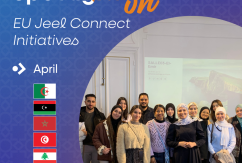
Countries covered:
-
 Algeria
-
Egypt
-
Jordan
-
Lebanon
-
Morocco
-
Tunisia