






























 Algeria
  Bahrain
  Egypt
Egypt  Iran
Iran  Iraq
Iraq  Israel
  Jordan
  Kuwait
  Lebanon
  Libya
Libya  Morocco
  Oman
Oman  Palestine *
  Qatar
Qatar  Saudi Arabia
  Syria
Syria  Tunisia
  United Arab Emirates
  Yemen
Yemen EMNES Working Paper 42: Global Value Chains – Participation and firm productivity: Evidence from Egypt


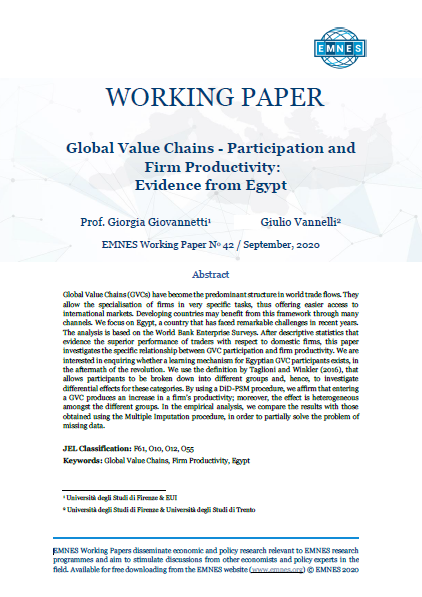
Global Value Chains (GVCs) have become the predominant structure in world trade flows. They allow the specialisation of firms in very specific tasks, thus offering easier access to international markets. Developing countries may benefit from this framework through many channels. The focus is on Egypt, a country that has faced remarkable challenges in recent years. The analysis is based on the World Bank Enterprise Surveys.
After descriptive statistics that evidence the superior performance of traders with respect to domestic firms, this paper investigates the specific relationship between GVC participation and firm productivity. The authors are interested in enquiring whether a learning mechanism for Egyptian GVC participants exists, in the aftermath of the revolution.